A founding team in Germany, 2026

What We Build

Three things, and they belong together. An agent for one job, an architecture sized to that job, and the harness that makes the agent testable.

  • Tested on real cases
  • Every step traced
  • A human signs
  • Model and hosting are your choice
01

Vertical agents

An agent for one job in one industry. It knows the forms, the norms and the exceptions, and it stops where a human has to decide.

A narrow scope makes the agent testable. One job has a known set of inputs, a known set of rules and a known person who checks the result.

  • Knows the forms and norms of one field
  • Asks back when a case is unclear
  • Hands over a draft for a person to decide
02

Custom architectures

A single prompt rarely carries a whole workflow. We split the work into an orchestrator, specialist agents, tools and an audit log, and we keep the number of parts as small as the job allows.

We pick the model per task. A large model may plan, a small local model may read out fields, and plain code does the arithmetic.

  • An orchestrator and specialist agents
  • Tools and sources declared up front
  • Plain code where code is enough
  • Open-weight models where they fit
03

Harness engineering

The scaffolding around the agent: scenarios from real cases, evaluation runs, traces, guards and replay. It is the part that turns a demo into something a team can rely on.

We write the harness before the agent is finished. Its results show when the agent is good enough to put in front of a reviewer.

  • Scenarios from your real cases
  • A score after every change
  • Traces a reviewer can read

Architecture

The point where a human signs is a design decision we make first. Everything in front of it is built so that the signature means something.

Inside the guards: scope, data and actions are limited

Request arrives. A form, a drawing or a mail. The agent records what it was given, for example three files and the form type.

Orchestrator plans. It splits the case into tasks. When something is missing or unclear it asks back, and the question goes into the trace.

Specialists work. Small agents with one skill each check the rule, run the numbers and write the draft. Each may only use the tools and sources declared for it.

Harness checks. Guards block actions outside the scope. The result is scored against the scenarios, and the score goes into the trace.

Human signs. The reviewer reads the draft and the trace with its sources, questions and score. Then they sign, or send it back with a note.

1 of 5
Trace: one record for the whole caseillustration
  1. 01case received
  2. 013 files read
  3. 01form type found
  4. 02plan: 3 tasks
  5. 021 question open
  6. 02asked the clerk
  7. 03rule checked
  8. 03source cited
  9. 03draft written
  10. 04guards passed
  11. 0412 of 12 checks
  12. 04score stored
  13. 05signed
  14. 05by a person
  15. 05or sent back

How We Work

A project has five steps. Each step ends with something your team can look at and judge.

  1. Listen

    We sit with the people who do the work today. We note where the time goes, which cases are routine and which need a person.

  2. Collect cases

    Together we pick real cases, the awkward ones included, and write down what a good result looks like. These become the scenarios.

  3. Build small

    We build the smallest architecture that handles those cases. Every tool, model and data source is listed before it is used.

  4. Harness

    The agent runs against all scenarios after every change. You see the score, the traces and the cases that still fail.

  5. Hand over

    Your team runs a pilot and signs off on it. We document how the agent is built, what it may do and how it was tested.

This is how we plan to run our first projects. We will adjust it to what we learn in the interviews.

Worked Example

An illustration of one agent we could build: the completeness check for a building permit application. The case is made up. The steps are the ones we would test.

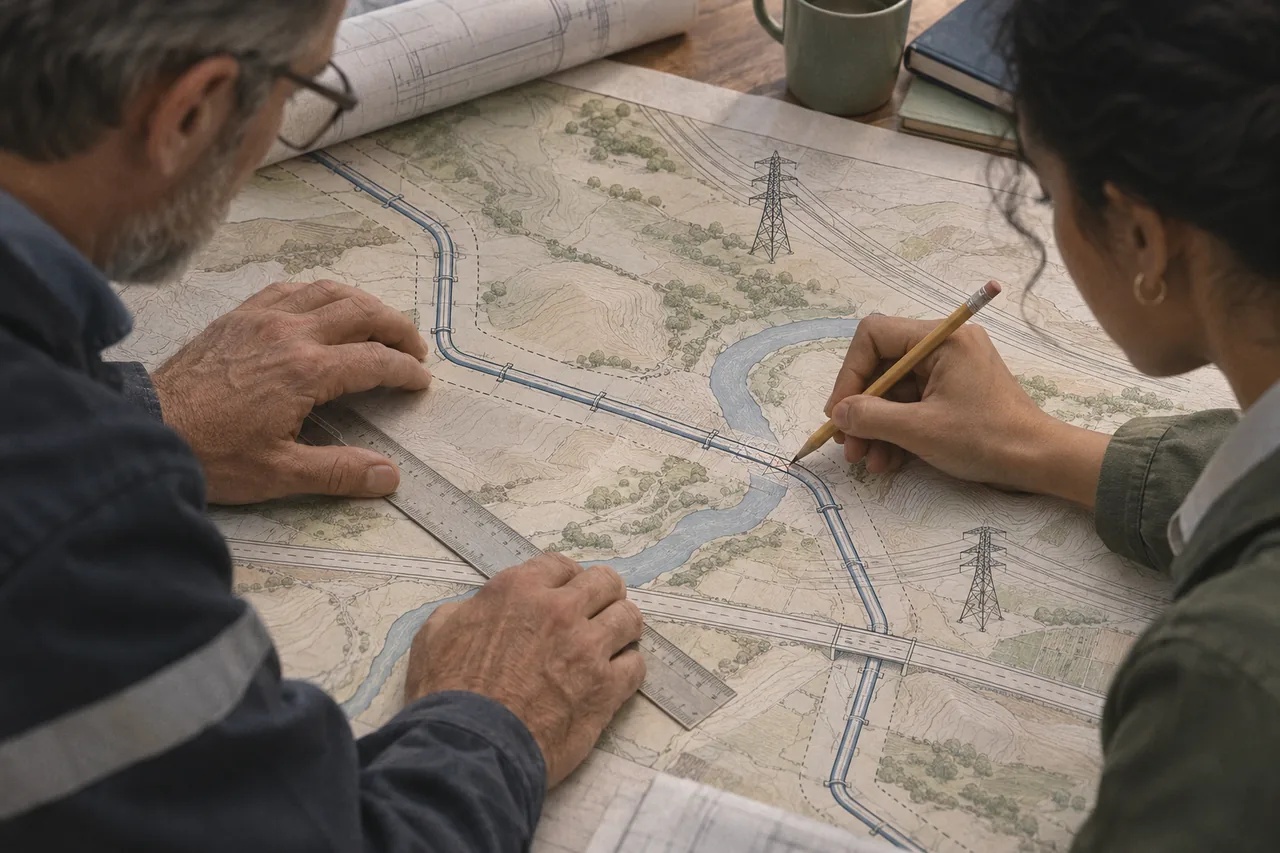
Two pairs of hands mark a crossing on a printed pipeline route with a pencil and a ruler. Generated image
  1. InputAn application arrives as a bundle of PDF files: forms, site plan, drawings and structural documents.
  2. SortThe agent separates the documents and names each one.
  3. CompareIt compares the bundle with the list of required documents for this type of building in this federal state.
  4. DraftFor each missing document it writes one line with the reason and the rule it relied on.
  5. Hand overThe clerk sees the review sheet and decides. The agent sends nothing on its own.

Fields

The method stays the same, the field is still open. Six fields on the table. None is decided. We score them this autumn and take one or two into customer interviews.

01

Security

Agents that test and defend AI systems, and the compliance work that EU product rules create for makers of connected devices and software.

  • Red-team tests of an agent before it goes live
  • An inventory of AI systems for the AI Act
exploring
02

Education

AI literacy for companies, and for people who have never used an assistant. Training first, a product later if the demand is there.

  • Role-based training for staff who use AI
  • Practice cases built from your own documents
exploring
03

Care

Assistants for carers, and products against loneliness for older people. Who pays is the open question.

  • Documentation drafts for care staff
  • Companion software with clear limits
exploring
04

Commerce

Agents that buy on behalf of people, and shops that are ready to be found and read by agents.

  • Product data that agents can read
  • Purchase approvals with a person in the loop
exploring
05

Personal products

Cards, maps and small apps generated for one person or one occasion, and thrown away after use.

  • Cards and maps made for one occasion
  • Small apps with an audit trail
exploring
06

Infrastructure and administration

Agents for planning, permits and public services, where staff are short, the work follows forms, and a human signs at the end. This is where we expect the harness to matter most.

  • Completeness checks for permit applications
  • Pre-checks of grid connection documents
  • Site diary and protocol drafts for site supervision
first interviews

How We Decide

Each founder scores each field on six criteria, alone and before the meeting. Weighted scores decide which one or two go into interviews. The weights are a proposal until the team has changed them once.

  1. 01Desk research (done)
  2. 02First filter
  3. 03Interviews
  4. 04Decision
Criteria and weights (maximum weighted score 65)
  • Competence3
  • Customers3
  • Resources2
  • Excitement2
  • Market2
  • Timing1