Concept

Approach

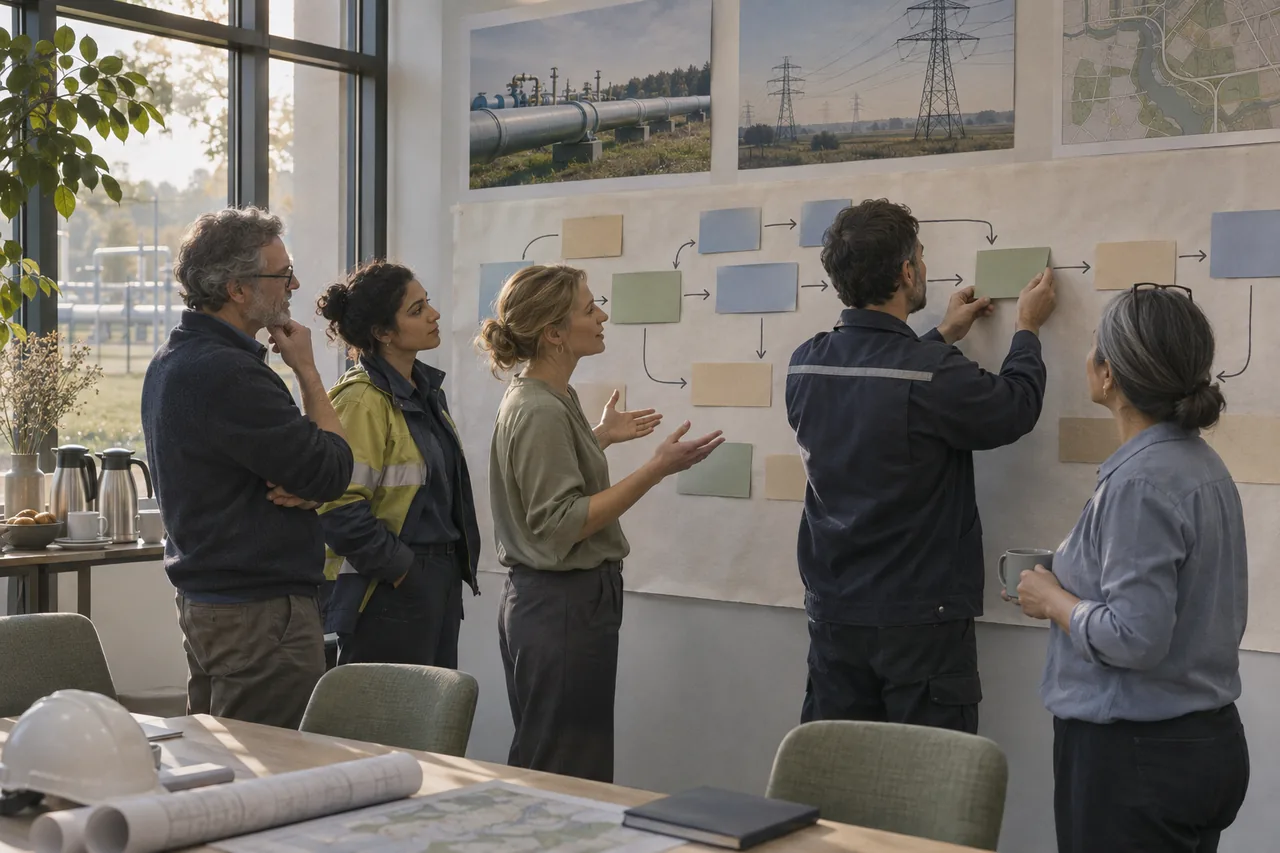
Six steps, and the first one is a workshop on site. We learn the work from the people who do it, write it down as a map, and build the app from that map.

Five people stand at a wall of paper cards and arrows that map a work process. One moves a card, the others discuss. Generated image
Illustration workshop board stepstermsnormsfailures check specification first on site
Board and table: the steps, the terms, the norms and the cases that go wrong. Each open question carries an owner, the dot.
Step 01, before day 1

Workshop

A workshop on site with the people who do the work. We write down the steps, the terms, the norms they work to and the cases that go wrong. Every open question gets an owner. Before any agent drafts, we agree on what will be checked.

Who is in the room
  • Tender author
  • Project lead
  • Our team
Leaves the step
Steps, sample cases, open questions, the check specification
Illustration, sample workflow
Rules from the room
Agreed first
Illustration

The map scrolls sideways.

Phases across, sources down, drawn from the sample workflow. The two narrow columns are the signature gates.
Step 02, after the workshop

Workflow Map

For every step we name the system it reads, the data it needs and what a good result looks like. The data can be documents and norms, expert knowledge, records in your systems, and extended data such as geodata or sensor readings where a step needs them. The map also decides what each agent may read.

Who is in the room
  • Tender author
  • Project lead
  • Our team
Leaves the step
Workflow map, data list, rules for a good result
Illustration, sample workflow
Case
Documents
Extended data
Systems of record
Illustration Document storePlan registerGIS layer realm app Tender package intakedraftcheck rules, templates, norm list pinned by version and hash connectors, read only event bus agentic os, kernel SchedulerMemoryShelvesModel gateway ConnectorsAudit logEvent busTest bench
Your app lives in your realm. Connectors reach your systems, the kernel underneath is the same for every app.
Step 03, the build

Your App

The workflow becomes an app in your realm on the agentic OS. It holds your content, your connectors, your rules and the agents for each step. The platform underneath is the same for every app.

Who is in the room
  • Our team
Agents in the app
  • Intake agent
  • Drafting agent
  • Check agent
Leaves the step
An installed app with pinned agents and connectors
Illustration, sample workflow
Agents
Tools
Kernel parts
Illustration code checks schema units quantities, 5 % references allowed norms no placeholder planted errors must fire model judge not yet in use gradedby people judge score agreement, kappa
Left, what code decides. Right, a model judge. It counts only once its grades agree with grades people gave by hand, and in our runs they do not agree well enough yet.
Step 04, before release

Validation

Code checks what code can decide: structure, units, quantities, references and the allowed norms. Planted errors show that each check fires. A model judge may grade the rest once its grades agree with grades people gave by hand. Today no judge grade counts.

Model judge: not yet in use

Who is in the room
  • Tender author
  • Our team
Agents in the step
  • Check agent
Leaves the step
Test results per step, judge agreement, failing cases
Illustration, sample workflow
Gold set
Draft 1
After review
A project lead at her desk reads a printed tender document with sticky notes and is about to sign its last page. Generated image
Illustration gate 1gate 2 input, test planrelease role, name, time, hashhash, open items run agents never sign
One person signs the input and the test plan, another person signs the release.
Step 05, day 1 and day 3

Sign-off

Two people sign. One signs the input and the test plan, another signs the release. Agents never sign.

Who is in the room
  • Tender author, Gate 1
  • Project lead, Gate 2
Leaves the step
Two signatures in the evidence record
Illustration, sample workflow
Gate 1
Gate 2
Evidence
Two colleagues at a desk go through a printed report with a chart and a table. One marks a single row with a red pencil, the other writes a note. Generated image
Illustration run numbers failed case new test checks, draft 2
Every run reports its numbers. A failed case turns into a new test before the next run.
Step 06, after release

Tune and Measure

Every run reports its numbers. A failed case becomes a new test, and only after a person approves it. Templates, house standards and norm lists are tuned together with the tender author.

Who is in the room
  • Operator
  • Platform team
Leaves the step
Numbers per run, new test cases, a tuned app
Illustration, sample workflow
After release
Time today
1 of 6

Illustration, sample workflow

Workflow Map

Nine phases of one sample workflow, the tender for a cable route, and the sources each phase needs. The map comes out of the workshop. It also decides what each agent may read.

PhaseDocumentsNorms and standardsExtended dataExpert knowledgeSystems of record
The map is filled by approach.js from the sample workflow data.

Extended data is whatever the work needs beyond the documents: geodata of a route, sensor readings, a site survey. The map records which of it a step may use.